Salad Spinners
A salad spinner takes the sog out of salads by spinning water off washed greens in seconds, so dressing clings instead of sliding off. This guide covers what matters, from capacity and mechanism to storage, and tracks real spinners across every budget.
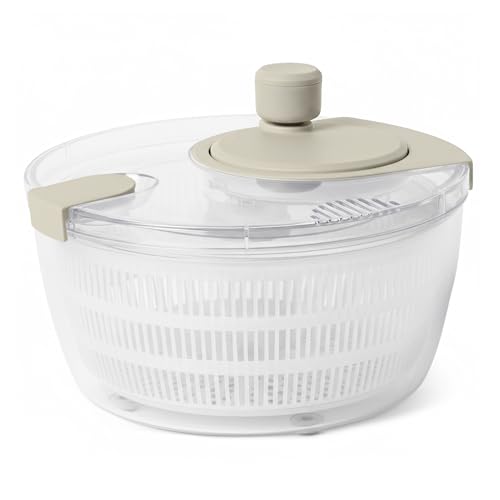
Which type do you need?
Pump / push
- One-hand operation
- Quick, effortless spinning
- Easy push-down action
- Fast drying
- More parts to clean
Pull-cord / crank
- Strong spin power
- Durability
- Powerful spin
- Simple mechanism
- Two hands needed
Find the right salad spinner
| Your need | Best type | Start here |
|---|---|---|
| The best all-round pick | Pump / push | Best salad spinners |
| Compare everything | All products | Full database |
Explore salad spinners
Start here
Salad Spinner database
PantryGear Lab tracks 16 salad spinner models with sourced specifications. Here is a representative preview; the full table adds filters and sorting.
| Model | Material | Dishwasher-safe | Weight | Action |
|---|---|---|---|---|
| Amazon Basics Salad Spinner with Non-Skid Base and S | Plastic | — | 1.6 lb | Check price |
| Brieftons Large 6.2-Quart Collapsible Salad Spinner: | Plastic | — | — | Check price |
| CLIVIA 5 Gal/20 Qt Large Commercial Salad Spinner Ju | — | — | — | Check price |
| COOK WITH COLOR Collapsible Salad Spinner - 4 QT Spa | — | — | 1.2 lb | Check price |
| Cambom Salad Spinner Lettuce Spinner | — | — | — | Check price |
| Cuisinart Large Spin Stop | — | — | — | Check price |
| Cuisinart Salad Spinner- Wash | — | — | 1.4 lb | Check price |
| GATBO Commercial Salad Spinner | — | — | 5.8 lb | Check price |
| KitchenAid Universal Salad Spinner | — | — | — | Check price |
| Lunememo Stainless Steel Salad Spinner | Stainless steel | — | — | Check price |
View all 16 salad spinners, with filters & sorting →
What matters when choosing a salad spinner
Match to your household: 3 to 4 quarts for one or two, 5 to 6 quarts for families and batch washing.
A pump lets you spin one-handed; a pull-cord or crank spins harder. Both dry greens well; pick by preference.
A non-slip base keeps the spinner still on the counter, which matters as the basket spins at speed.
A basket that doubles as a colander and a bowl you can serve from add real everyday value.
How PantryGear Lab researches salad spinners
We track real products using verified specifications and current listings, recorded by brand and dated on capture. We never publish a figure we cannot source.
Frequently asked questions
What's the difference between a salad spinner and a colander?
A colander only drains water by gravity, while a salad spinner uses centrifugal force to fling water off the leaves, which dries greens far faster and more thoroughly.
Can you wash a salad spinner in the dishwasher?
Most baskets and outer bowls are dishwasher-safe on the top rack, but check the specific model first since some pump or crank lids house gears that shouldn't get submerged.
How often should you clean a salad spinner to avoid mold?
Rinse and air-dry it fully after each use, and give the basket, bowl, and lid a deeper wash at least once a week if you use it daily, since trapped moisture around the gears is where mold usually starts.
What's the best salad spinner size for weekly meal prep?
A 6 to 7 quart bowl handles a full week's worth of chopped greens in one or two loads, which is why most meal-prep cooks size up rather than choosing a compact model.
Do salad spinners work for anything besides lettuce?
Yes, they're commonly used for rinsing and drying herbs, berries, cherry tomatoes, and even pasta or rice after a cold rinse, as long as the basket mesh is fine enough to hold the ingredient.