Best Food Processors
The best food processor for you comes down to bowl size and how hard you push it. For most kitchens a 12 to 14-cup machine with a wide feed tube covers chopping, slicing, shredding and dough; minis handle herbs and sauces. These are our research-based picks across sizes and budgets.
We evaluate products using verified specifications, manufacturer documentation, current product listings, replacement-part availability, feature comparisons and recurring buyer-feedback patterns. Where reliable hands-on evidence is available, we incorporate it separately and label it clearly.
For most kitchens, a 12 to 14-cup food processor with a wide feed tube is the best all-round choice; choose a mini (3 to 4-cup) for herbs and sauces, or a high-wattage model if you knead dough often.
Top picks
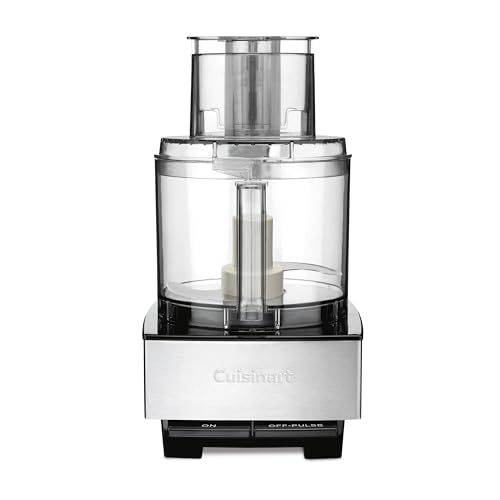
Cuisinart DFP-14BCNY (14-Cup)
Families & all-round prep
The long-standing benchmark: a 14-cup bowl, wide feed tube and the build to knead dough and slice in volume. If you want one processor to do everything, this is the safe default.
Check price on Amazon Read review
Hamilton Beach 70725AG (12-Cup)
Most kitchens on a budget
A 12-cup Stack & Snap that skips the fiddly locking twist, at a fraction of premium prices. Plenty of capacity for everyday chopping, slicing and shredding.
Check price on Amazon Read review
Ninja BZ601 (9-Cup)
Bread & pizza dough
A 9-cup processor built with a dough setting, so it handles kneading that bogs down lighter machines. A good pick if dough is a regular job.
Check price on Amazon Read review
Cuisinart DLC-2ABC (3-Cup)
Herbs, garlic & sauces
The classic 3-cup Mini-Prep for small jobs: chopping herbs, mincing garlic, and whizzing dressings and sauces. Cheap, tiny to store and easy to clean.
Check price on Amazon Read review
Cuisinart FP-8GMP1 (8-Cup)
Everyday couples & small families
An 8-cup bowl hits the sweet spot between capacity and counter space, covering most daily prep without the bulk of a 14-cup machine.
Check price on Amazon Read review
Cuisinart DLC-8SY (11-Cup)
Hard foods & heavy use
An 11-cup processor with a 625-watt motor for dense vegetables and stiff dough, for cooks who push a processor hard and want headroom.
Check price on Amazon Read review
BLACK+DECKER FP4200B-RF (8-Cup)
Occasional use
An 8-cup processor at an entry price that still slices, shreds and chops for everyday needs, for anyone who wants the function without spending much.
Check price on Amazon Read reviewIn-depth reviews
Cuisinart DFP-14BCNY (14-Cup)
Best for: Families & all-round prep
The long-standing benchmark: a 14-cup bowl, wide feed tube and the build to knead dough and slice in volume. If you want one processor to do everything, this is the safe default.
Check price on AmazonHamilton Beach 70725AG (12-Cup)
Best for: Most kitchens on a budget
A 12-cup Stack & Snap that skips the fiddly locking twist, at a fraction of premium prices. Plenty of capacity for everyday chopping, slicing and shredding.
Check price on AmazonNinja BZ601 (9-Cup)
Best for: Bread & pizza dough
A 9-cup processor built with a dough setting, so it handles kneading that bogs down lighter machines. A good pick if dough is a regular job.
Check price on AmazonCuisinart DLC-2ABC (3-Cup)
Best for: Herbs, garlic & sauces
The classic 3-cup Mini-Prep for small jobs: chopping herbs, mincing garlic, and whizzing dressings and sauces. Cheap, tiny to store and easy to clean.
Check price on AmazonCuisinart FP-8GMP1 (8-Cup)
Best for: Everyday couples & small families
An 8-cup bowl hits the sweet spot between capacity and counter space, covering most daily prep without the bulk of a 14-cup machine.
Check price on AmazonCuisinart DLC-8SY (11-Cup)
Best for: Hard foods & heavy use
An 11-cup processor with a 625-watt motor for dense vegetables and stiff dough, for cooks who push a processor hard and want headroom.
Check price on AmazonBLACK+DECKER FP4200B-RF (8-Cup)
Best for: Occasional use
An 8-cup processor at an entry price that still slices, shreds and chops for everyday needs, for anyone who wants the function without spending much.
Check price on AmazonHow we evaluate food processors
Matched to real use, from 3-cup minis to 14-cup family machines.
Enough wattage for dough and dense vegetables without bogging down.
Wide feed tubes and slicing/shredding discs for less pre-cutting.
Dishwasher-safe parts, since a processor has several pieces to wash.
Frequently asked questions
What size food processor do I need?
For families or batch prep, a 12 to 14-cup bowl. For everyday couples, 8 to 10 cups. For herbs, garlic and sauces, a 3 to 4-cup mini. Bigger bowls handle dough and slicing in volume but take more storage.
How many watts should a food processor have?
Around 400 to 600 watts suits most tasks. Higher wattage helps with stiff dough and dense vegetables; lighter motors can bog down under heavy loads.
Can a food processor knead dough?
Yes, many can, especially full-size models with a dough blade and a stronger motor. Work in shorter bursts, and for large or frequent dough batches choose a higher-wattage machine.
Food processor vs blender, what is the difference?
A food processor chops, slices, shreds and kneads dry and solid foods in a wide bowl. A blender purees liquids and smoothies in a tall jar. They overlap a little but are built for different jobs.