Best Meat Grinders
Meat grinders vary far more than their price tags suggest. The motor rating (rated versus misleading "peak" wattage), grinding-head size, housing and drivetrain materials, number of plates, reverse function, sausage attachments, duty cycle and cleaning difficulty all change how a grinder performs and how long it lasts. This guide compares real, currently listed grinders on those factors and recommends models for everyday home use, game processing and tight budgets. Our assessment is based on verified specifications, manufacturer documentation, current listings and recurring buyer-feedback patterns rather than a claim that every unit was bench-tested.
We evaluate meat grinders using verified specifications, manufacturer documentation, current product listings, replacement-part availability, feature comparisons and recurring buyer-feedback patterns. Where reliable hands-on evidence exists we incorporate it separately and label it clearly. We never publish fake ratings, fake test hours or unverified specifications.
For everyday home grinding the AAOBOSI covers burgers and sausage; the metal-built LEM BigBite #8 is the game and bulk workhorse; the CHEFFANO is the budget pick. Match motor, build and head size to how much you grind.
Top picks

AAOBOSI Electric Meat Grinder
Everyday home grinding & sausage
A feature-rich home grinder with a 3-speed touch control, auto-reverse to clear jams, a stainless head and included sausage tubes. The most versatile pick for regular burgers, grinds and home sausage making.
Check price on Amazon Read review
LEM BigBite #8 Meat Grinder
Deer, game & bulk batches
A metal-built #8 grinder with a genuine 0.5 HP rated motor, made for hunters and households processing large, tough batches where durability and honest power matter more than features.
Check price on Amazon Read review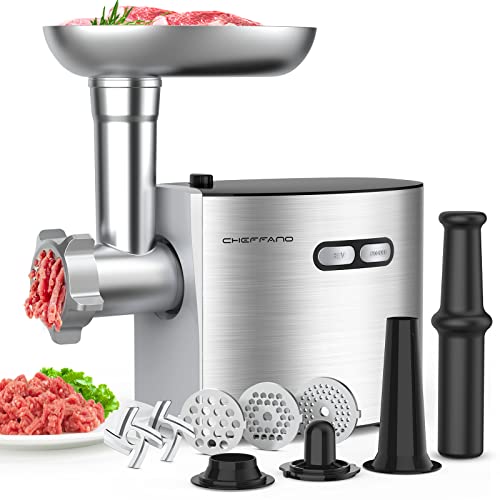
CHEFFANO Meat Grinder
Occasional use & budget buyers
An affordable, ETL-certified grinder that ships with three grinding plates and sausage tubes. A sensible entry point for occasional grinding and small batches without spending much.
Check price on Amazon Read reviewHow they compare
| Model | Best For | Motor / power | Construction | Reverse | Sausage kit | Weight | |
|---|---|---|---|---|---|---|---|
| AAOBOSI Electric | Everyday home & sausage | 3000W peak | Stainless steel | Yes (auto) | Yes | 9.5 lb | View on Amazon |
| LEM BigBite #8 | Game & bulk | 0.5 HP (rated) | Stainless steel | — | Yes | 32.6 lb | View on Amazon |
| CHEFFANO | Occasional & budget | 2800W peak | Metal & ABS | — | Yes | 8.0 lb | View on Amazon |
| Aiheal Electric | Home use | 3200W peak | Stainless steel | — | Yes | — | View on Amazon |
| ALTRA LIFE | Value / light use | 2300W peak | Stainless steel | Yes | Yes | 6.3 lb | View on Amazon |
Model identity, specifications and links verified from live listings and manufacturer sources. A dash (—) means the figure is not stated; confirm the current price on Amazon.
In-depth reviews
AAOBOSI Electric Meat Grinder
Best for: Everyday home grinding and sausage
A well-rounded home grinder that pairs a stainless grinding head with a 3-speed touch panel and auto-reverse. It is the model we would point most home cooks to for regular burgers, grinds and sausage.
Check price on AmazonWhy it made our list
It earns the top spot on versatility rather than raw power. The stainless head, multiple speeds and auto-reverse make it easy to run and easy to clear when tough cuts bind, and the included sausage and kubbe attachments cover home charcuterie without a second purchase. For the everyday buyer who grinds a few pounds regularly, that balance beats a heavier single-purpose machine.
Key specifications
- Three speeds plus automatic reverse to clear jams
- Stainless grinding head is easy to keep food-safe
- Includes sausage and kubbe attachments
- Simple touch controls suit occasional users
- "3000W" is a peak figure; continuous power is much lower
- Heavier and bulkier on the counter than budget units
- Touch panel and some parts are plastic
- Not an all-metal drivetrain for season-long game processing
How it compares
Against the LEM BigBite #8, the AAOBOSI is the better routine-household choice: it is lighter, has more convenience features (multiple speeds, auto-reverse, a touch panel) and includes sausage tubes out of the box. The LEM pulls ahead only when a genuine rated-horsepower motor, a metal drivetrain and repeated heavy batches matter more than storage, features or price. Put simply, choose the AAOBOSI for regular home grinding and sausage, and step up to the LEM if game and durability outweigh convenience.
What to watch for before buying
For a feature-focused home grinder like this, the things to weigh before buying are the gap between its peak and continuous power, its counter footprint and cleanup time. Its convenience features, the touch control, auto-reverse and included sausage tubes, are the reason to choose it over a barebones unit rather than any performance edge we can independently verify.
You grind regularly at home, want sausage capability, and value ease of use and features over commercial-grade durability.
You process deer or grind large batches regularly; a metal-drivetrain grinder with a rated-horsepower motor will last longer under that load.
LEM BigBite #8 Meat Grinder
Best for: Deer, game and bulk processing
A metal-built #8 grinder with an honest 0.5 HP rated motor. It is heavier, pricier and less flashy than home units, and that is exactly the point for hunters and bulk processors.
Check price on AmazonWhy it made our list
Where most home grinders quote peak wattage, LEM quotes a rated horsepower, which is the number that matters when you feed a machine sinewy game for an hour. The stainless build and metal drivetrain are made to survive repeated heavy batches, and LEM's replacement-part and accessory ecosystem means a worn plate or knife does not retire the machine.
Key specifications
- Genuine rated HP instead of peak-wattage marketing
- Metal drivetrain and stainless build for durability
- #8 head throughput suits game and bulk
- Strong replacement-part and accessory availability
- Heavy and large; not for small kitchens
- Higher price than home-grade units
- Overkill for occasional burger grinding
- Fewer convenience features than touch-screen home models
How it compares
Against the AAOBOSI, the LEM wins on the fundamentals that matter for hard use: a manufacturer-rated 0.5 HP motor instead of a peak-wattage figure, a metal drivetrain and a genuine #8 head. What it gives up is convenience and portability, it is much heavier, pricier and has fewer features than the touch-screen AAOBOSI. If you process game or grind large batches often, the LEM is the safer long-term buy; if you grind occasionally at home, its size and cost are hard to justify over the AAOBOSI.
What to watch for before buying
As a metal-drivetrain #8 grinder, its case rests on durability and an honestly rated motor rather than features. The practical costs to weigh are its weight and price, which only make sense if you process in volume; for light use, a smaller unit is easier to store and cheaper.
You hunt or buy in bulk, regularly grind large or tough batches, and want a machine with a metal drivetrain and real HP that will last for years.
You only grind a few pounds a few times a year; the size, weight and price are hard to justify for light use.
CHEFFANO Meat Grinder
Best for: Occasional use and budget buyers
An affordable grinder that still ships with three plates and sausage tubes. It covers occasional grinding cleanly, as long as you keep expectations in line with the price.
Check price on AmazonWhy it made our list
Not everyone needs a game grinder. For buyers who grind a few times a year, the CHEFFANO delivers the essentials, coarse and fine plates plus a sausage kit, with ETL safety certification, at a price well below dedicated home or commercial units. It is the right amount of grinder for light, occasional work.
Key specifications
- Low price for a complete starter kit
- Three grinding plates included
- Sausage tubes in the box
- ETL safety certification
- Peak-wattage marketing overstates continuous power
- More plastic components than premium units
- Shorter practical duty cycle for long sessions
- Not suited to game or repeated bulk batches
How it compares
Against the AAOBOSI, the CHEFFANO competes purely on price. Both are peak-wattage home units with sausage capability, but the CHEFFANO ships with three plates for less, while the AAOBOSI adds multiple speeds, auto-reverse and a stainless head that suit more regular use. Against the LEM, there is no real contest on durability: the LEM is a rated-HP, metal-drivetrain machine for game, while the CHEFFANO is built for occasional light-duty batches. Choose the CHEFFANO to spend the least for occasional grinding; move up only if you grind regularly or process game.
What to watch for before buying
As a budget grinder, the sensible expectation is essentials done adequately within light-duty use. More plastic components and a shorter practical duty cycle are the usual trade-offs at this price, so keep it to occasional batches; pushing it into game or bulk processing is where a budget unit shows its limits.
You grind occasionally, want sausage capability, and prioritise a low price over commercial durability.
You process game or grind large batches regularly; a metal-drivetrain grinder will outlast it and save frustration.
How we evaluate meat grinders
Head size, rated motor power, throughput and suitability for tougher cuts.
Housing, gears, auger and head material, plus component availability.
Assembly, controls, reverse function, feeding and stability.
Removable parts, awkward crevices and food-contact materials.
Sausage tubes, plates, kubbe attachment and speed settings.
Capability, construction, included accessories and warranty against price.
How to choose
For burgers and regular grinding, a mid-range electric with multiple plates and reverse is enough.
Choose a rated-HP, metal-drivetrain #8 or #12 for sinewy game and bulk.
Focus on the essentials: motor, stainless parts and reverse; skip gimmicks.
Compact, lighter models suit light or infrequent grinding and storage.
Confirm the kit includes stuffing tubes and plate sizes for the sausage you want.
Choosing a meat grinder is mostly about matching one number to your reality: how much meat you actually grind, and how tough it is. Everything else, plates and attachments and speeds, follows from that. Here is what each specification means and where the trade-offs lie.
Grinder size (#5, #8, #12, #22)
Grinders are numbered by the diameter of the grinding head and plates. A #5 is small and light for occasional home use. A #8 is the common home-to-prosumer size, a good balance of throughput and storage for burgers, sausage and moderate game. A #12 steps up head size and motor for larger batches and regular game processing, and a #22 is semi-commercial territory for high volume. Bigger heads take wider feed and clear tough cuts faster, but they cost more, weigh more, and are harder to store. Most households are well served by a #8; only buy up if you genuinely process in bulk.
Rated horsepower vs peak wattage
This is the single most misread spec. Many home grinders advertise a large "max" or "peak" wattage, 2,000 to 3,000W or more, while their continuous (rated) power is only a few hundred watts. Peak is a momentary figure the motor can hit briefly, not what it sustains. A grinder that quotes a large peak wattage and one that quotes a modest rated horsepower can behave very differently under a long, sinewy load. For everyday grinding, peak-rated home units are generally fine. For frequent game and larger batches, a genuine rated-horsepower figure and a metal drivetrain become increasingly important, because rated (continuous) power is what holds speed when the load gets tough. Compare rated figures where a manufacturer publishes them rather than relying on the peak number on the box.
How much meat you process
Be honest about volume. If you grind a few pounds a handful of times a year, an entry-level electric or even a manual grinder is enough. Regular family use, weekly burgers or batch cooking, suits a mid-range #8. Hunters and homesteaders processing game or larger, repeated batches benefit from a metal-drivetrain machine with a rated-horsepower motor and a larger head, because throughput and heat build-up become the limiting factors on light units.
Drivetrain and materials
The housing gets the attention, but the drivetrain decides durability. Metal gears and a metal auger survive repeated heavy loads; plastic gears are fine for light, occasional grinding but are the first thing to strip under sustained use. A stainless grinding head and food-contact parts resist wear and are easier to keep clean and rust-free. If you plan to process game, insist on a metal drivetrain even if the housing looks similar to a cheaper unit.
Grinding plates
Plates set the grind. A coarse plate handles chili and a first pass on tougher cuts; a medium plate suits most burgers and sausage; a fine plate gives a tight grind for hot dogs and pâté. Most grinders ship with two or three plates. Confirm the plate sizes match your model and that replacements are available, because a warped or dull plate, not the motor, is often what ends a grind.
Reverse function
A reverse setting runs the auger backward to clear a jam when sinew wraps the screw. It is a genuine convenience on longer sessions and game processing, where clogs are common. On light, occasional use it matters less, but it is a feature worth having if you grind anything tough.
Sausage stuffing and attachments
If sausage is on your list, check that the grinder includes stuffing tubes and that the auger pushes ground meat steadily rather than smearing it. Kubbe attachments and multiple tube sizes add versatility. A grinder sold with a sausage kit is the easiest entry point; adding tubes later is possible but confirm compatibility first.
Duty cycle and heat
Electric grinders have a duty cycle, a limit on continuous run time before the motor needs to rest. Budget units have shorter cycles and warm up faster, which is fine for small batches but frustrating on a big one. Keeping meat and parts cold reduces smearing and eases the load, extending how long you can run before pausing.
Cleaning
Cleaning is why grinders get shelved. More removable parts and simple disassembly make cleanup faster; many metal parts are not dishwasher-safe and should be hand-washed and dried to prevent rust. Running a little bread or cracker through before disassembly pushes out residual meat. Factor in how the head, auger, blade and plate come apart before you buy.
Replacement parts
Blades, plates and augers are wear items. A grinder from a brand with a strong replacement-part ecosystem can be renewed for years; one with no available spares becomes disposable when a plate dulls or a gear wears. This is a real, often-overlooked difference between a cheap grinder and a durable investment.
Budget tiers
Entry-level grinders cover occasional home grinding and basic sausage at a low price, usually with more plastic and a shorter duty cycle. Mid-range units add stronger motors, more metal, reverse and better plates, suiting regular family use. Heavy-duty and semi-commercial grinders bring metal drivetrains, real rated HP and large heads for game and bulk, at a much higher price and weight. Moving up a tier mostly buys durability and throughput, not features, so match the tier to how hard and how often you will actually run the machine.
The short version. Decide your real volume first. Occasional cook: entry-level or manual. Regular home use: a mid-range #8 with reverse and metal gears. Game or bulk: a rated-HP, metal-drivetrain #8 or #12 with strong parts availability. Read "peak" wattage as marketing, and prioritise the drivetrain over the sticker number.
Which one is right for you?
- You grind small quantities
- You use it occasionally
- Storage space matters
- Budget is the priority
- You process deer or game
- You regularly grind large, repeated batches
- Throughput and duty cycle matter
- You want a metal drivetrain and rated HP
- Usage is rare
- Electricity is unavailable
- You only process very small batches
- Quiet operation matters
Frequently asked questions
What size meat grinder is best for home use?
For occasional to regular household grinding, a mid-range electric grinder (often marketed around a #8 head or 2000 to 3000W peak) handles burgers, sausage and small batches. Buy a larger #12 or a rated-HP machine only if you grind in volume or process game, since bigger grinders cost more and take much more storage.
What grinder size is best for deer and game?
Game processing rewards a metal-drivetrain grinder with a genuine, manufacturer-published horsepower rating, typically a #8 or #12. These handle sinewy cuts and larger, repeated batches without bogging, which peak-wattage home units tend to struggle with over long sessions. Prioritise rated power and drivetrain materials over the peak wattage printed on the box.
How much horsepower do I need in a meat grinder?
Focus on the rated (continuous) power, not the peak or "max" wattage on the box. Many home grinders advertise 2000 to 3000W peak but run on a few hundred watts continuously, which is fine for regular home grinding. For game and bulk, prioritise a grinder that publishes a genuine rated horsepower rather than a peak figure, since rated power is what sustains speed under load.
Can a meat grinder grind bones?
Most home meat grinders are not designed to grind bones and doing so can damage the auger and blade. Only specific grinders rated for raw pet-food or bone grinding should be used for soft bones, and always follow the manufacturer's guidance.
Can a meat grinder make sausage?
Yes, if it includes stuffing tubes and the auger pushes ground meat steadily. Remove the blade and plate, fit the tube, and feed casings. Grinders sold with a sausage kit and kubbe attachment are the easiest starting point.
Are stainless-steel meat grinders better?
A stainless housing and metal grinding head resist wear and are easier to keep food-safe than plastic. What matters most for durability, though, is the drivetrain: metal gears and auger outlast plastic internals under repeated heavy use.
How do you clean a meat grinder?
Unplug it, disassemble the head, auger, blade and plate, and wash them by hand (many parts are not dishwasher-safe). Dry metal parts fully to prevent rust, and run a little bread or cracker through before disassembly to push out residual meat.
Electric vs manual meat grinder: which is better?
Electric grinders are faster and far less tiring for bulk, game and sausage; manual grinders are cheaper, quieter, need no power and suit rare, small batches. Choose electric if you grind regularly or in volume, manual for occasional light use.