How to Choose a Salad Spinner: A Buying Guide
Start by matching bowl capacity to how many people you cook for, then choose a pump-action or pull-cord mechanism based on hand strength and storage space. Check the basket mesh fineness against the greens you buy most, and confirm the base has a non-slip ring so the bowl won't slide during a fast spin.
Choosing a salad spinner comes down to matching a few real design decisions to how your kitchen actually works, not just grabbing whichever bowl looks biggest on the shelf. Capacity gets most of the attention online, and we've covered that ground elsewhere on this site, so this guide instead pulls together the pieces that decide whether a spinner feels effortless or fights you at the sink: how the mechanism actually spins, whether the base holds still, how fine the basket mesh is, and where it lives when you're not using it. Get these right alongside capacity, and almost any spinner in your price range will earn its spot in the cabinet.
Which type do you need?
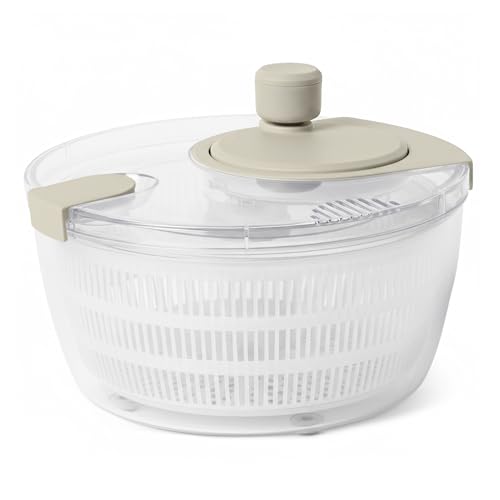
Pump-Action Spinners
Best for kids, sore wrists, and repeatable spins
- Works well for kids, older cooks, or anyone with grip or wrist issues
- Builds to full spin speed in just a handful of presses
- Simple gear train that tends to hold up for years
- Raised plunger adds height, which can be tight under low cabinets
- Worn lid gaskets on older units can spray water during pumping

Pull-Cord Spinners
Best for fast, low-profile spins
- One or two firm pulls often build more momentum than several pumps
- Lower lid profile fits better on shallow cabinet shelves
- Fewer moving parts sit near the water-facing seal
- Requires a stronger, single-motion grip that not everyone has
- Budget cords can fray or slip off the spool with heavy use
Find the right salad spinner for your needs
| Your need | Best type | What to look for | Start here |
|---|---|---|---|
| Everyday cooking for a family | Pump-action, 6 quarts or more | Wide bowl, sturdy gear mechanism | OXO Good Grips 6.22 Qt Salad Spinner |
| Small kitchen, one or two people | Pull-cord, 3 to 4 quarts | Low lid profile, easy one-hand storage | Cuisinart Salad Spinner |
| Backup spinner or light, occasional use | Either, 4 to 5 quarts | Non-slip base, simple cleanup | Amazon Basics Salad Spinner with Non-Skid Base |
| Heavy daily use, wants it to last | Pump-action, stainless bowl | Metal gears, rust-resistant bowl | SveBake 5.3Qt Stainless Steel Salad Spinner |
Key features that actually matter
A two-person kitchen rarely needs more than 3 to 4 quarts, while a family making salad most nights benefits from 6 quarts or more.
A brake lets you stop the basket the instant it feels dry, while a freewheel design coasts on its own momentum and can fling water onto the counter if left spinning.
A wide rubber ring or suction feet keep the bowl planted on the counter during fast spins, and a heavier bowl resists tipping better than a light one.
Wide mesh drains fast but lets small herb leaves or shredded cabbage slip through, while a finer weave holds delicate greens without letting them poke through.
Some bowls nest inside the basket and lid as one compact stack, and collapsible silicone models fold nearly flat, both useful when storage space is tight.
Polycarbonate is lighter and cheaper to replace, while a stainless steel outer bowl resists cracking and staining from beet juice or turmeric.
Pump-Action vs Pull-Cord: key differences
| Feature | Pump-Action | Pull-Cord |
|---|---|---|
| Hand strength needed | Low, light repeated presses | Moderate, one firm continuous pull |
| Speed to full spin | Builds gradually over several presses | Often reaches top speed in one or two pulls |
| Mechanism upkeep | Simple gear train, rarely needs attention | Cord and spool can wear or slip after years of use |
| Storage profile | Taller lid because of the plunger | Flatter lid, easier to slide onto a shelf |
Get more water out without bruising the leaves
Load the basket only about two-thirds full and spin in two short bursts rather than one long one: a few seconds, a brief pause to let trapped water settle toward the bottom, then a shorter second burst. This two-stage approach pulls more water off the leaves than one continuous spin, because the pause gives water clinging to stacked leaves time to drain before the final pass. Overfilling the basket is the most common reason a spinner seems to not dry well, since leaves packed near the center never touch enough moving air to shed their water.
Common mistakes to avoid
- Overfilling the basket. So leaves in the middle stay wet no matter how long you spin.
- Buying on capacity alone. And ignoring how loud or physically demanding the mechanism feels after daily use.
- Choosing a fine mesh basket for hardy vegetables. Like shredded cabbage, which drains slower than it needs to.
- Skipping the non-slip base check. Then finding the bowl skates across the counter at full speed.
- Storing a bulky model in a cabinet too shallow for it. Then shoving it in a corner and reaching for paper towels instead.
Final checklist
- Matched bowl capacity to how many people you cook for regularly
- Picked pump-action or pull-cord based on hand strength and storage height
- Confirmed the base has a non-slip ring or feet
- Checked basket mesh fineness against the greens and herbs you use most
- Considered whether nesting or collapsible storage matters in your kitchen
- Weighed plastic against stainless steel for durability and cost
- Verified the lid seal fits snugly and parts are dishwasher-safe
- Looked at real-world spin time in reviews, not just the marketing claim
Frequently asked questions
What size salad spinner do I need for a family of four?
Look for at least 6 quarts of bowl capacity, which lets a family-size portion of greens spin in one load instead of two smaller batches.
Is a pump-action or pull-cord salad spinner easier to use?
Pump-action tends to be easier for kids, older cooks, or anyone with wrist or grip issues, since it builds speed through light repeated presses rather than one strong pull.
Can a salad spinner handle fresh herbs without tearing them?
Yes, as long as the basket uses a finer mesh weave, which supports delicate leaves like basil or cilantro better than the wider mesh made for sturdier vegetables.
Does a heavier salad spinner work better than a lighter one?
A heavier bowl combined with a non-slip base keeps the spinner planted on the counter during fast spins, while very light models can walk or wobble at top speed.
How do I know if a salad spinner will fit my cabinet?
Pump-action models sit taller because of the plunger, while pull-cord and collapsible designs usually have a flatter profile that fits better on shallow shelves.