Best Pressure Canners
Pressure canners differ most in their gauge system and capacity. Dial-gauge stovetop canners show exact pressure and adjust precisely for altitude but need annual gauge testing; weighted-gauge canners self-regulate at set pressures with no testing; and electric canners run hands-off on their own element, within the maker's tested programs. Capacity, material and cooktop fit decide what and how much you can process. This guide compares real, currently listed canners on those factors and recommends models for large batches, first-time canners and hands-off use. Crucially, only a true pressure canner can safely process low-acid foods, and only with tested USDA processes. Our assessment is based on verified specifications and manufacturer documentation rather than a claim that every unit was bench-tested.
We evaluate pressure canners using verified specifications, manufacturer documentation, current product listings, safety-feature checks and parts availability, aligned with USDA and National Center for Home Food Preservation guidance. Where reliable hands-on evidence exists we incorporate it separately and label it clearly. We never publish fake ratings, fake test hours or unverified specifications, and we never give processing times or pressures as a substitute for tested recipes.
For large-batch stovetop canning the dial-gauge Presto 23-quart is a proven pick; the Presto 16-quart is an easier first canner; the NESCO NPC-9 is an electric option for hands-off use within its tested programs. Only a true pressure canner safely processes low-acid foods, using tested USDA recipes.
Top picks

Presto 23-Quart Pressure Canner
Large-batch stovetop canning
A classic aluminum stovetop canner with a dial gauge and weighted regulator, sized for a full load of quart jars. The proven choice for volume preservers who want precise pressure.
Check price on Amazon Read review
Presto 16-Quart Pressure Canner
First-time canners
A more manageable 16-quart stovetop canner with a clear manual and widely available parts, a common and less intimidating first canner.
Check price on Amazon Read review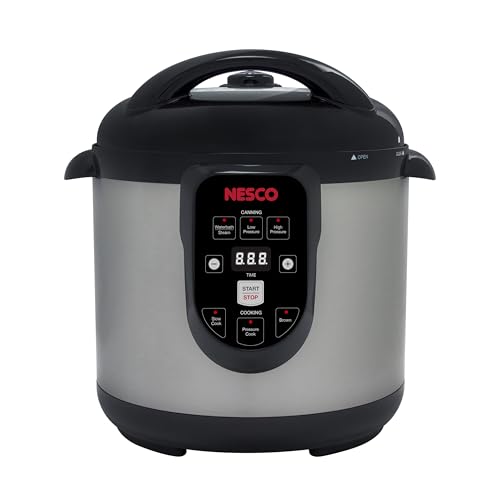
NESCO NPC-9 Electric Pressure Canner
Hands-off convenience
An electric canner that frees the stovetop and runs programmed cycles. Convenient, but only safe with the maker's tested canning programs.
Check price on Amazon Read reviewHow they compare
| Model | Best For | Type | Gauge | Capacity | Weight | |
|---|---|---|---|---|---|---|
| Presto 23-Quart | Large batches | Stovetop | Dial + weighted | 23 qt | 12.0 lb | View on Amazon |
| Presto 16-Quart | Beginners | Stovetop | Dial + weighted | 16 qt | 10.5 lb | View on Amazon |
| NESCO NPC-9 | Hands-off | Electric | Digital | — | 0.3 lb | View on Amazon |
| Barton 23-Quart | Budget large | Stovetop | Dial | 23 qt | 15.8 lb | View on Amazon |
| Presto 01784 | Large batches | Stovetop | Dial + weighted | 23 qt | 12.5 lb | View on Amazon |
Model identity, specifications and links verified from live listings and manufacturer sources. A dash (—) means the figure is not stated; confirm the current price on Amazon.
In-depth reviews
Presto 23-Quart Pressure Canner
Best for: Large-batch stovetop canning
The classic large-batch canner. An aluminum stovetop unit with a dial gauge and weighted regulator that suits volume preservers who want precise pressure control.
Check price on AmazonWhy it made our list
It earns the top spot on capacity and precision. The 23-quart body takes a full load of quart jars, the aluminum heats quickly, and the dial gauge lets you set pressure exactly for your altitude, with the weighted regulator giving an audible confirmation. Widely available gaskets and gauges mean it keeps working for many seasons, which is why it is a long-standing home-canning staple.
Key specifications
- Full load of quart jars in one batch
- Precise dial-gauge pressure for altitude
- Widely available replacement parts
- Proven, long-standing design
- Dial gauge needs annual testing
- Aluminum is not suited to every cooktop
- Large and heavy when full
- No hands-off automation
How it compares
Against the Presto 16-quart, the 23-quart adds capacity for volume canning but is heavier and takes a bigger burner. Against the NESCO electric, it offers the full range of tested stovetop recipes and precise control, while giving up the electric model's hands-off convenience and free stovetop. Choose the 23-quart for large batches and precision, the 16-quart for an easier start, and the NESCO if you want hands-off operation within tested programs.
What to watch for before buying
For a dial-gauge stovetop canner, the things to weigh are the annual gauge testing and the cooktop fit rather than any question of capability. Its precise pressure control and large capacity are the reasons to choose it over a smaller or weighted-only canner.
You preserve in volume, want precise altitude-adjustable pressure, and are willing to have the dial gauge tested each season.
You want minimal maintenance or a smaller, lighter canner; a weighted-gauge or 16-quart model fits better.
Presto 16-Quart Pressure Canner
Best for: First-time canners
A more approachable stovetop canner. The same proven Presto design in a smaller, easier-to-handle size that makes a sensible first canner.
Check price on AmazonWhy it made our list
Its appeal is manageability. At 16 quarts it still processes a useful batch of pints or quarts, but it is lighter and less daunting to fill, vent and move than a 23-quart. The clear manual and available parts help a beginner follow tested processes correctly, which matters far more than raw capacity when you are learning.
Key specifications
- Manageable size for first-time canners
- Precise dial-gauge control
- Clear manual and available parts
- Lighter to handle than a 23-quart
- Smaller batches than a 23-quart
- Dial gauge still needs annual testing
- Aluminum cooktop limitations
- No electric automation
How it compares
Against the 23-quart, the 16-quart trades capacity for a lighter, less intimidating canner that suits learning. Against the NESCO electric, it keeps the full stovetop recipe range and precise control but asks you to tend the stove. Choose the 16-quart to start, size up to the 23-quart for volume, or go electric for hands-off convenience.
What to watch for before buying
As a smaller stovetop canner, its case is ease of handling for people learning the process, not maximum throughput. The trade-off is batch size; if you preserve in volume, the 23-quart is the better fit.
You are new to pressure canning or preserve smaller batches and want a manageable, proven stovetop canner.
You already can in volume; the 23-quart's larger capacity will serve you better.
NESCO NPC-9 Electric Pressure Canner
Best for: Hands-off convenience
A countertop electric canner that frees the stovetop and automates the cycle. Convenient, with the firm condition that you stay within its tested canning programs.
Check price on AmazonWhy it made our list
The draw is convenience: it runs on its own element, follows a programmed cycle and does not tie up a burner, which suits people short on stovetop space or who prefer a hands-off process. NESCO markets the NPC-9 specifically for canning, so, used with its tested programs and recipes, it brings automation to a task that usually demands attention.
Key specifications
- Frees the stovetop entirely
- Programmed, hands-off cycles
- Marketed and tested for canning
- Countertop convenience
- Only safe with maker-tested programs
- Smaller capacity than a 23-quart stovetop
- Cannot run every stovetop recipe unchanged
- More electronics that can fail than a plain pot
How it compares
Against both Presto stovetop canners, the NESCO trades capacity and the full tested-recipe range for hands-off convenience and a free stovetop. It is the pick if automation and counter operation matter most and you will follow its tested programs; the stovetop Prestos are better for large batches, precise control and the widest range of USDA recipes.
What to watch for before buying
As an electric canner, its case rests on convenience and automation rather than capacity or recipe range. The important limit is that it must be used strictly within the manufacturer's tested programs; treat it as a validated appliance, not a general canner.
You want hands-off, countertop canning within tested programs and prefer not to tie up the stove.
You need large batches, the full range of tested stovetop recipes, or precise manual pressure control.
How we evaluate pressure canners
Dial for exact pressure, weighted for self-regulation, electric for programmed cycles.
Quarts and jars per load against how much you preserve at once.
Aluminum versus stainless, and induction and burner fit.
Overpressure release, locking lid, working vent and gauge accuracy.
Availability of gaskets, gauges and seals for a long service life.
Capacity, gauge system and build against price and warranty.
How to choose
A 23-quart dial-gauge stovetop canner takes a full load of quart jars.
A 16-quart stovetop canner is easier to handle while you learn the process.
A weighted-gauge canner needs no annual gauge testing.
An electric canner frees the stove, used within its tested programs.
A dial gauge lets you set the exact pressure your recipe requires.
Choosing a pressure canner comes down to the gauge system, capacity and cooktop fit. Here is the short version; our full pressure canner buying guide covers each factor in depth.
- Dial-gauge stovetop — shows exact pressure and adjusts precisely for altitude, but the gauge needs annual testing.
- Weighted-gauge stovetop — self-regulating at set pressures, no gauge testing, confirmed by the regulator's jiggle.
- Electric — hands-off and frees the stove, but only safe with the maker's tested canning programs.
Size to your batches (a 23-quart canner takes a full load of quart jars), confirm the canner fits your cooktop including induction if needed, and check that gaskets and gauges are available. Above all, pressure-can low-acid foods only in a true pressure canner using tested USDA or National Center for Home Food Preservation processes, never a water-bath pot or an ordinary pressure cooker.
Which one is right for you?
- You want precise pressure
- You can at altitude
- You preserve in volume
- You will test the gauge yearly
- You want low maintenance
- You prefer no gauge testing
- Set pressures suit your recipes
- You like an audible confirmation
- You want hands-off operation
- Stovetop space is limited
- You will use tested programs
- Convenience outweighs capacity
Frequently asked questions
What is the best pressure canner for most home canners?
A stovetop Presto in the 16 to 23-quart range covers most home canning with precise, adjustable pressure and widely available parts. Choose a larger 23-quart for volume, a 16-quart for an easier start, or an electric canner for hands-off use within its tested programs. Always follow tested USDA recipes for your food, jar size and altitude.
Dial-gauge or weighted-gauge?
A dial gauge shows exact pressure and adjusts precisely for altitude but must be tested each season; a weighted gauge self-regulates at set pressures with no testing. Many stovetop canners include both. Choose dial for precision, weighted for low maintenance.
Can I use an Instant Pot or pressure cooker for canning?
No. Ordinary pressure cookers and electric multicookers such as the Instant Pot are not endorsed for pressure canning low-acid foods, even models with a "canning" button, unless the manufacturer publishes validated processes. Use a true pressure canner and tested USDA recipes.
What size pressure canner do I need?
Match capacity to how much you preserve at once. A 16-quart canner suits smaller batches and is easier to handle; a 23-quart takes a full load of quart jars for volume canning. Remember the canner must fit and be stable on your burner when full.
Are electric pressure canners safe?
Only when used exactly as the manufacturer tested them, with validated canning programs for the food you are processing. Do not run a stovetop recipe unchanged on an electric canner, and never use a general multicooker for canning low-acid foods.
Do I need to test the gauge?
A dial gauge should be tested each season, usually through a local extension office, because an inaccurate gauge is a real safety risk with low-acid foods. A weighted-gauge canner needs no gauge testing, which is part of its appeal.
Aluminum or stainless pressure canner?
Aluminum heats quickly and is lighter, which suits large canners; stainless is heavier and works on more cooktops, including many induction ranges. Check induction compatibility and burner size for whichever material you choose.